How Orion Pharma evaluates more drug targets, faster, with Elicit


Challenge
With many targets to assess and hundreds of papers behind each one, the volume can outpace what a team can work through by hand.
Challenge
With many targets to assess and hundreds of papers behind each one, the volume can outpace what a team can work through by hand.
Solution
Elicit screens large bodies of papers and pulls structured data into a single table, with each cell linked to a supporting quote in the source paper.
Results
Faster literature assessment supports earlier, better-informed decisions about which directions to pursue before committing significant resources.
Context
At Orion Pharma, machine learning and AI support the earliest stage of drug discovery, helping scientists assess which targets and compounds are worth pursuing. Orion Pharma is Finland's leading pharmaceutical company, research-led and globally operating, with products in more than 100 countries. This work sits right at the front of the pipeline, where early go/no-go calls shape the direction of subsequent research and development.
Serhii Vakal is Lead ML/AI Scientist in Orion Pharma’s Molecular Intelligence and Data unit, within Medicine Design, where he works as a deep expert applying AI and computational methods to early discovery. "It's part of our R&D strategy," he says. "As an innovative company, Orion Pharma keeps up with developments in the field, and the industry is increasing its use of AI." As competitors invest in the same direction, building that capability in-house supports Orion Pharma’s work in early discovery.
Much of that work begins in the scientific literature. Before a project is initiated, scientists evaluate candidate targets against large volumes of published research to judge whether they are worth pursuing. With many targets to assess and hundreds of papers behind each one, the volume can outpace what a team can work through by hand. These early decisions inform significant downstream research effort, so thorough literature assessment matters.
Context
At Orion Pharma, machine learning and AI support the earliest stage of drug discovery, helping scientists assess which targets and compounds are worth pursuing. Orion Pharma is Finland's leading pharmaceutical company, research-led and globally operating, with products in more than 100 countries. This work sits right at the front of the pipeline, where early go/no-go calls shape the direction of subsequent research and development.
Serhii Vakal is Lead ML/AI Scientist in Orion Pharma’s Molecular Intelligence and Data unit, within Medicine Design, where he works as a deep expert applying AI and computational methods to early discovery. "It's part of our R&D strategy," he says. "As an innovative company, Orion Pharma keeps up with developments in the field, and the industry is increasing its use of AI." As competitors invest in the same direction, building that capability in-house supports Orion Pharma’s work in early discovery.
Much of that work begins in the scientific literature. Before a project is initiated, scientists evaluate candidate targets against large volumes of published research to judge whether they are worth pursuing. With many targets to assess and hundreds of papers behind each one, the volume can outpace what a team can work through by hand. These early decisions inform significant downstream research effort, so thorough literature assessment matters.
“This saves a substantial amount of work”
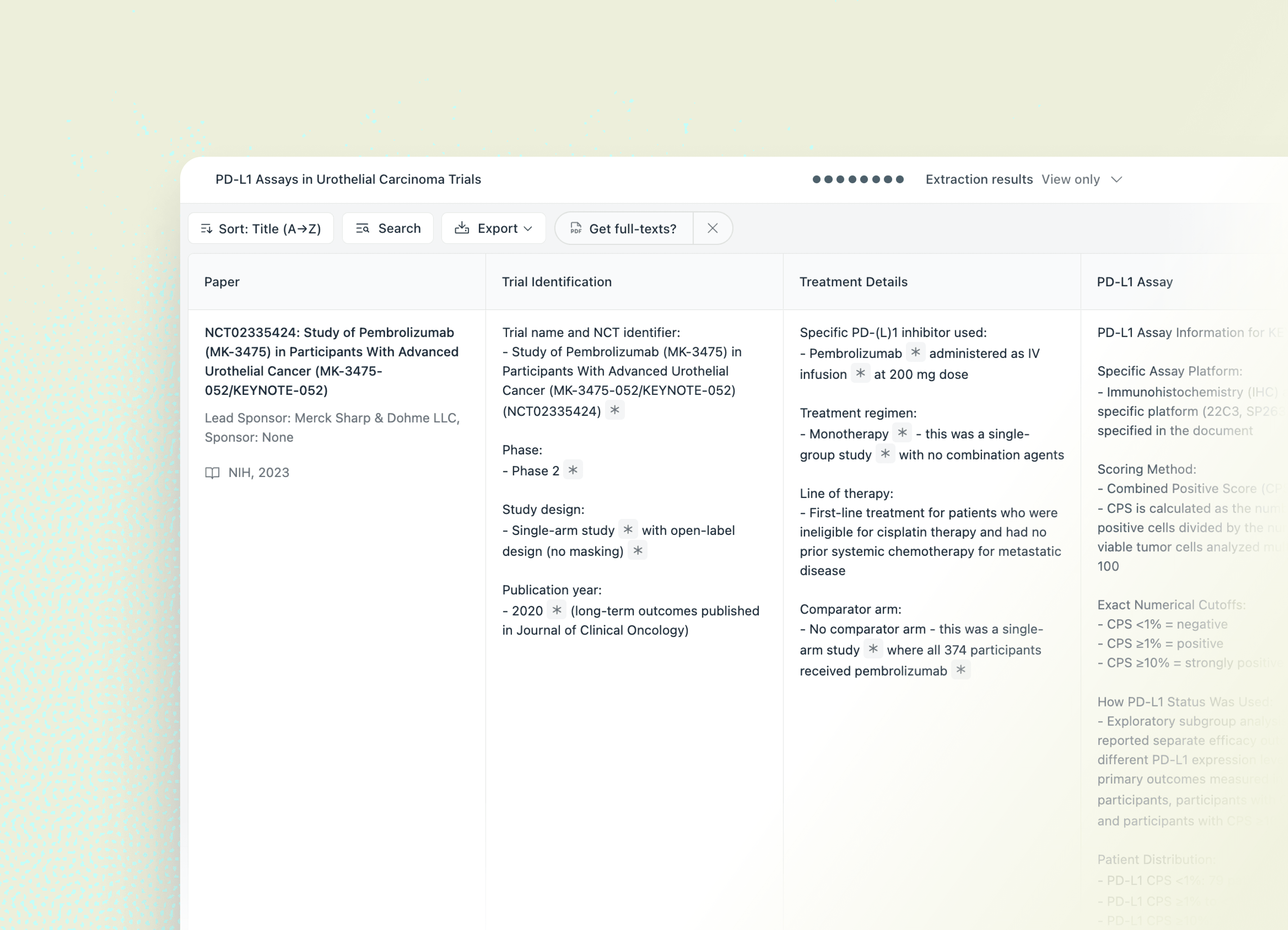
The use case Serhii returns to first is structured data extraction, the heart of Elicit's systematic literature review (SLR) product. It screens large bodies of papers and pulls structured data into a single table of rows and columns, with each cell linked to a supporting quote in the source paper.
On one project, the goal was to explore the literature broadly to identify compound classes of interest: "We take a step back and really dig into the literature," he says. The work began as a series of Elicit searches. Serhii outlined the groups where relevant molecules might be found, ran a search for each, and scored the results into a single ranked table of candidates. "Instead of going step by step through each paper, extracting it manually, now we can do it in a few minutes," he says. "That saves a considerable amount of work."
The time savings are meaningful. A single literature search that previously took on the order of days can now be completed in less than an hour, and larger multi-search projects compress accordingly.
The output fed into the project team, who reviewed the ranked list and selected compounds for further consideration. Elicit helped surface relevant, well-supported candidates rather than noise – useful when the molecules of interest are not easily described to a search tool in the first place.
“This saves a substantial amount of work”
The use case Serhii returns to first is structured data extraction, the heart of Elicit's systematic literature review (SLR) product. It screens large bodies of papers and pulls structured data into a single table of rows and columns, with each cell linked to a supporting quote in the source paper.
On one project, the goal was to explore the literature broadly to identify compound classes of interest: "We take a step back and really dig into the literature," he says. The work began as a series of Elicit searches. Serhii outlined the groups where relevant molecules might be found, ran a search for each, and scored the results into a single ranked table of candidates. "Instead of going step by step through each paper, extracting it manually, now we can do it in a few minutes," he says. "That saves a considerable amount of work."
The time savings are meaningful. A single literature search that previously took on the order of days can now be completed in less than an hour, and larger multi-search projects compress accordingly.
The output fed into the project team, who reviewed the ranked list and selected compounds for further consideration. Elicit helped surface relevant, well-supported candidates rather than noise – useful when the molecules of interest are not easily described to a search tool in the first place.
“The competitive advantage of Elicit is scale”
Serhii is clear about what sets Elicit apart. "The market is saturated with platforms that can do basic literature analysis, including open-source tools. But the competitive advantage of Elicit is the scale at which you can conduct extremely precise structured data extraction."
The payoff is not simply the same work done faster. With the same people, Orion can evaluate more targets in the same time and reach each assessment earlier.
Target selection is one of the less forgiving decisions in early discovery: many downstream choices in a program can be revisited later, but the choice of target is more foundational. Across the industry, well-characterized, evidence-supported target selection is widely associated with improved program success rates, making systematic target prioritisation a high-leverage activity upstream of the clinic. Published industry research has put a figure on what those success-rate gains are worth: DiMasi's analysis of drug-development productivity estimates that raising success rates from 21.5% to one in three would cut the capitalized cost per approved drug by US$221–242 million.
“The competitive advantage of Elicit is scale”
Serhii is clear about what sets Elicit apart. "The market is saturated with platforms that can do basic literature analysis, including open-source tools. But the competitive advantage of Elicit is the scale at which you can conduct extremely precise structured data extraction."
The payoff is not simply the same work done faster. With the same people, Orion can evaluate more targets in the same time and reach each assessment earlier.
Target selection is one of the less forgiving decisions in early discovery: many downstream choices in a program can be revisited later, but the choice of target is more foundational. Across the industry, well-characterized, evidence-supported target selection is widely associated with improved program success rates, making systematic target prioritisation a high-leverage activity upstream of the clinic. Published industry research has put a figure on what those success-rate gains are worth: DiMasi's analysis of drug-development productivity estimates that raising success rates from 21.5% to one in three would cut the capitalized cost per approved drug by US$221–242 million.
“The Research Agent is my favourite workflow in Elicit”
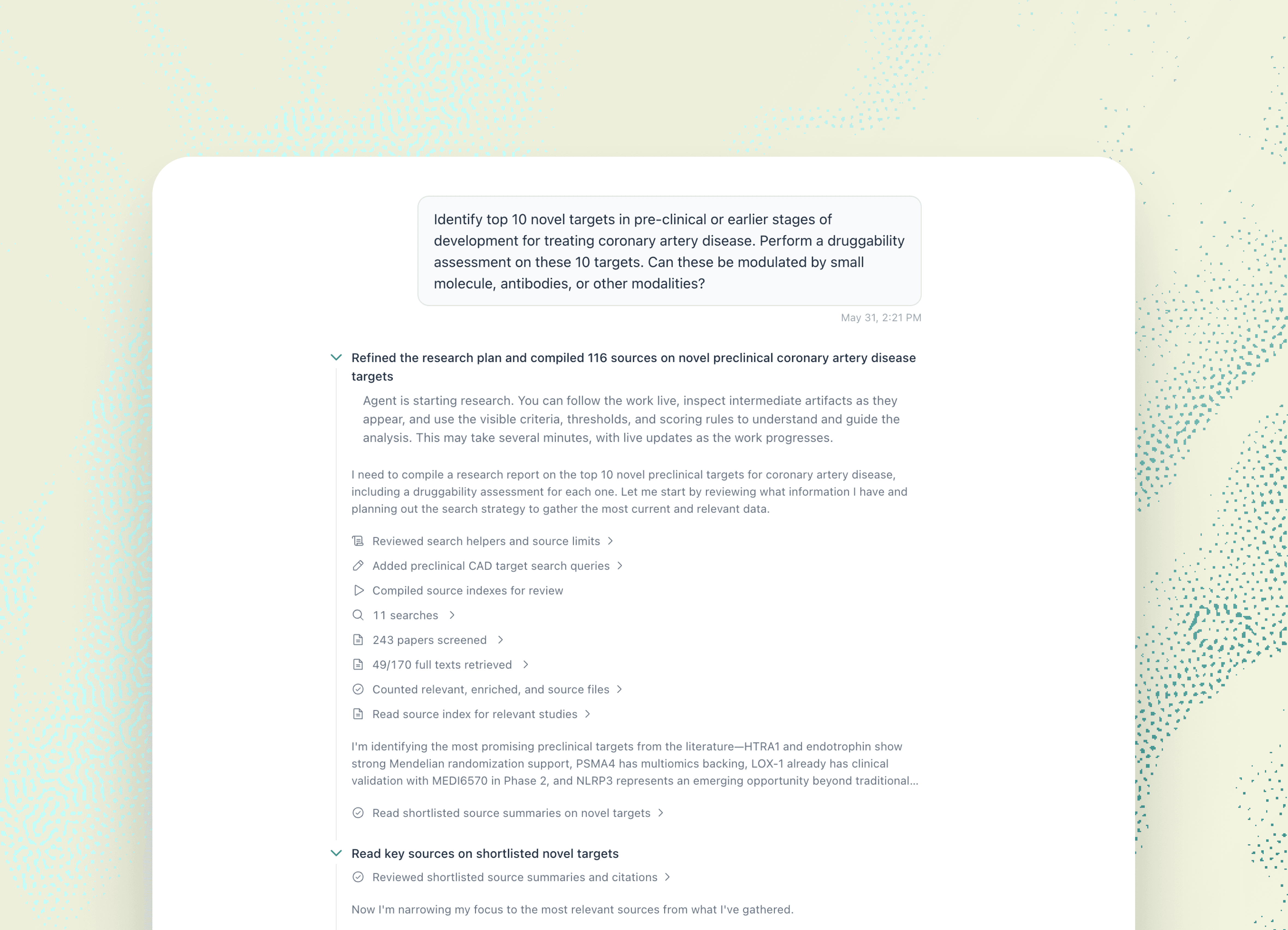
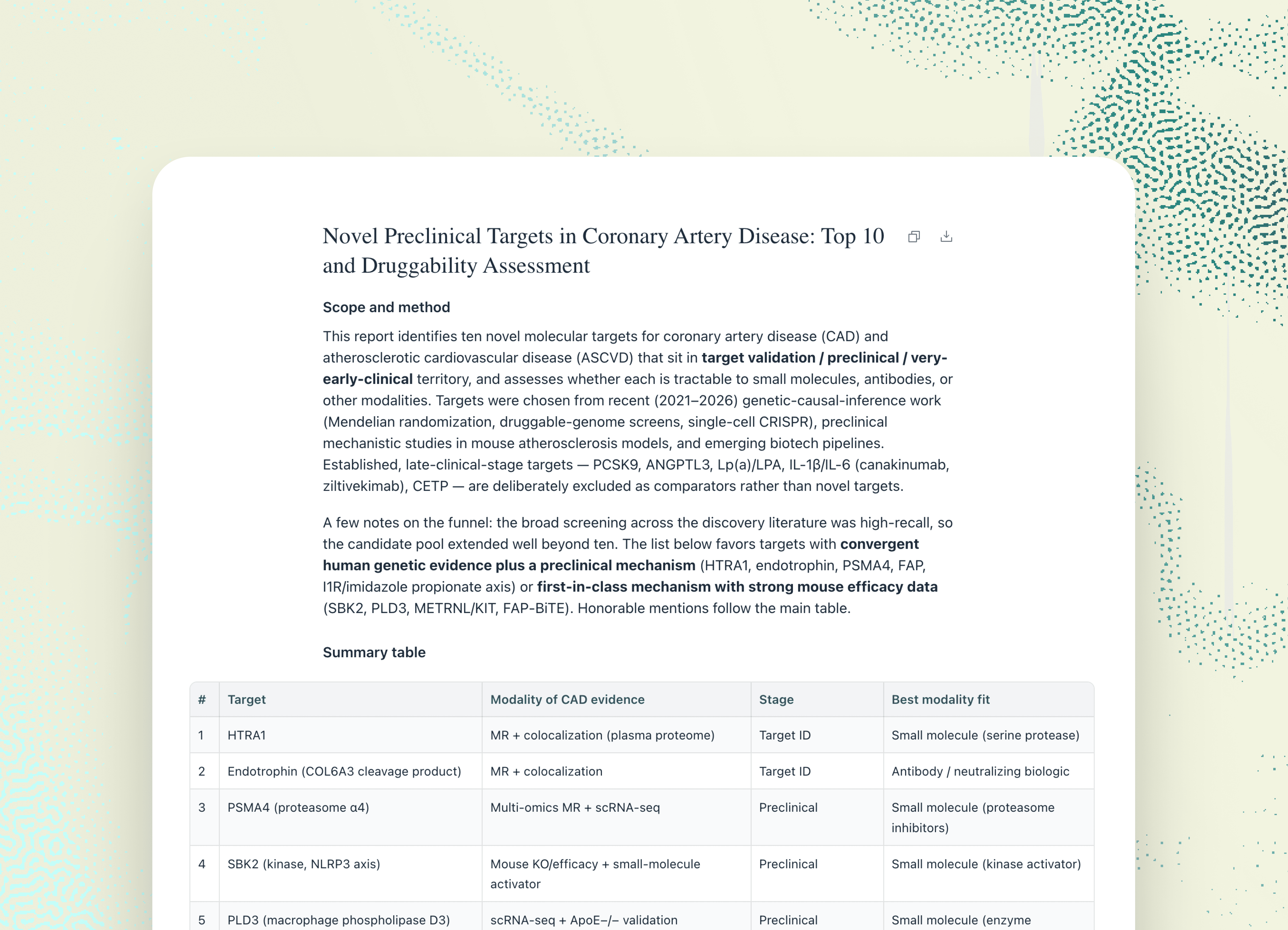
As Elicit has continued to develop, the Research Agent has become Serhii's default starting point. "This is now my favourite mode, and the first part of Elicit I turn to at project initiation. It's faster, and you can easily add more questions after the initial search has been completed."
It has opened up work that is harder to support with other tools. Competitive landscaping needs the most current picture possible, and in fast-moving areas the most recent information is not yet in peer-reviewed journals. "In something like generative AI for drug discovery, a large share of the relevant work is in preprints and blog posts. You cannot really find it in the traditional journals."
The Research Agent reaches beyond peer-reviewed literature into preprints, patents, and the wider web. It lets Serhii read the competitive landscape closer to real time, rather than on the lag of the publication cycle, and without the training cutoff that limits general-purpose AI tools. He tried the alternatives. "Elicit does much more exhaustive work in the same amount of time. Other reports were quite generic and superficial by comparison. The depth here is on a different level."
Where some of this work was previously entirely manual or handled through other channels, Serhii now keeps more of it in-house. "If we can do it straight away, in-house and upfront, of course it's much faster," he says. Initial data collection that previously took much longer can now be done in a fraction of the time.
“The Research Agent is my favourite workflow in Elicit”
As Elicit has continued to develop, the Research Agent has become Serhii's default starting point. "This is now my favourite mode, and the first part of Elicit I turn to at project initiation. It's faster, and you can easily add more questions after the initial search has been completed."
It has opened up work that is harder to support with other tools. Competitive landscaping needs the most current picture possible, and in fast-moving areas the most recent information is not yet in peer-reviewed journals. "In something like generative AI for drug discovery, a large share of the relevant work is in preprints and blog posts. You cannot really find it in the traditional journals."
The Research Agent reaches beyond peer-reviewed literature into preprints, patents, and the wider web. It lets Serhii read the competitive landscape closer to real time, rather than on the lag of the publication cycle, and without the training cutoff that limits general-purpose AI tools. He tried the alternatives. "Elicit does much more exhaustive work in the same amount of time. Other reports were quite generic and superficial by comparison. The depth here is on a different level."
Where some of this work was previously entirely manual or handled through other channels, Serhii now keeps more of it in-house. "If we can do it straight away, in-house and upfront, of course it's much faster," he says. Initial data collection that previously took much longer can now be done in a fraction of the time.
Learn more about these features
Learn more about
these features
The market is saturated with platforms that can do basic literature analysis, including open-source tools. But the competitive advantage of Elicit is the scale at which you can conduct extremely precise structured data extraction.
“I really appreciate that you are constantly developing the tool”
Beyond any single feature, Serhii values Elicit’s pace of product development. "I really enjoy that you’re improving the tool all the time, and that you're listening to what companies like Orion are looking for. The Research Agent: we didn't have it at first, and since its release it’s become a major component of my work."
Literature analysis is one important input among several in Orion Pharma’s early research, alongside the substantial internal target evaluation and feasibility work the company conducts. Where it applies, the gains from faster literature assessment add up. The same teams can now evaluate more candidate targets without adding headcount, widening the funnel of opportunities Orion Pharma can pursue. Faster literature assessment supports earlier, better-informed decisions about which directions to pursue and which to set aside before committing significant resources – complementing, not replacing, Orion Pharma’s own scientific research. Once a bottleneck at the front of discovery, the literature is now a source of speed.
“I really appreciate that you are constantly developing the tool”
Beyond any single feature, Serhii values Elicit’s pace of product development. "I really enjoy that you’re improving the tool all the time, and that you're listening to what companies like Orion are looking for. The Research Agent: we didn't have it at first, and since its release it’s become a major component of my work."
Literature analysis is one important input among several in Orion Pharma’s early research, alongside the substantial internal target evaluation and feasibility work the company conducts. Where it applies, the gains from faster literature assessment add up. The same teams can now evaluate more candidate targets without adding headcount, widening the funnel of opportunities Orion Pharma can pursue. Faster literature assessment supports earlier, better-informed decisions about which directions to pursue and which to set aside before committing significant resources – complementing, not replacing, Orion Pharma’s own scientific research. Once a bottleneck at the front of discovery, the literature is now a source of speed.
If you’re interested in Elicit for enterprise or institutional use, reach out to us at sales@elicit.com for more information regarding our security, or to request a copy of our SOC 2 Type II report under NDA.
If you’re interested in Elicit for enterprise or institutional use, contact us here.
About
Orion Pharma develops and markets human and veterinary medicines, with a focus on oncology and pain.
Industry
Pharma
Company size
2K–10K
Founded
1917
headquarters
Espoo, Finland